
 Trigeminal Neuralgia: Five Dentists, One Root Canal and Finally a Diagnosis
Tony Williams is Chair of TNA UK. He is also someone who knows what trigeminal neuralgia feels like from the inside.
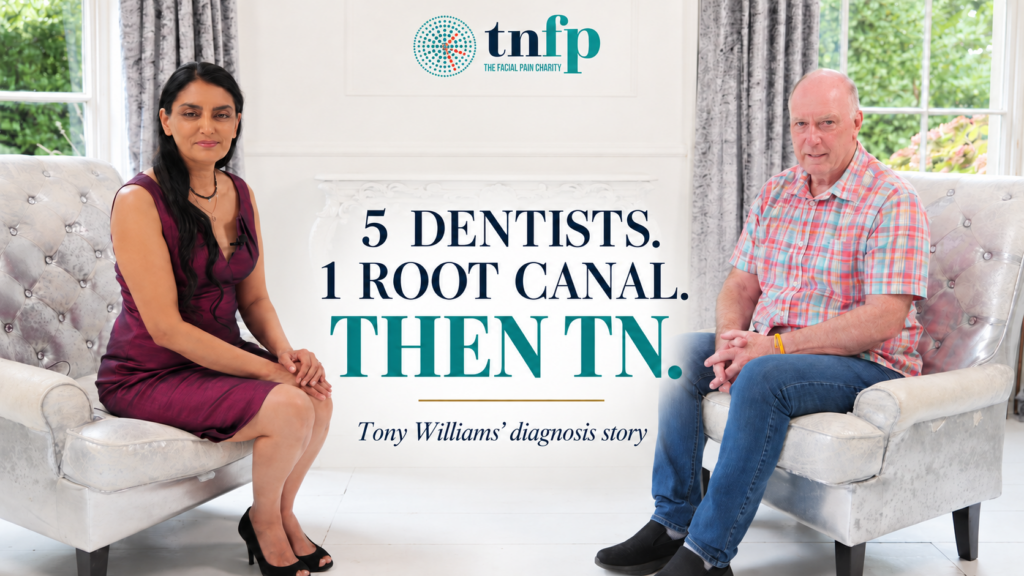
When I sat down with Tony to talk about his experience, one part of his story kept coming back to me: before anyone recognised trigeminal neuralgia, he saw five dentists.
He also underwent a root canal.
Tony’s pain had started quite innocently. He first noticed it while shaving his upper lip. It was mild at first, but over the following days and weeks it became stronger. Then it began to feel like a toothache.
If you develop pain around your teeth or mouth, going to a dentist is an entirely understandable thing to do. Tony did exactly that.
What followed was a journey that I think deserves to be heard.
Five dentists
Tony told me that the first dentist took an X-ray but could not find anything obviously wrong. Further dental appointments followed. By the third dentist, Tony was in considerable pain and underwent root canal treatment, despite there being no clear dental explanation for what he was experiencing.
He went home hoping that was the end of it.
The next day, the pain returned in the same place.
Tony eventually saw a fifth dentist, someone who happened to practise close to where he lived. This dentist listened to what Tony was describing, opened a book and raised a condition Tony had never heard of before:
trigeminal neuralgia.
That moment stayed with me.
Tony had gone from dentist to dentist trying to understand pain that felt as though it must be coming from his teeth. Then one person recognised that the answer might lie somewhere else.
The NHS itself explains that trigeminal neuralgia pain is often felt in the jaw, teeth or gums, and that many people visit a dentist before going to a GP. A dentist will quite properly look for common dental causes first.
That is why dental awareness of trigeminal neuralgia matters.
Not because every unexplained toothache is TN. It is not.
Not because people should diagnose themselves. They should not.
But because when the usual dental explanations do not fit, recognising the pattern of trigeminal neuralgia can make an enormous difference.
“It felt like toothache”
Tony described those early symptoms very simply:
“It felt a little bit like a toothache.”
That sentence tells us a great deal.
Trigeminal neuralgia can cause sudden, severe facial pain that may be felt in the teeth, jaw, gums or cheek. It is often described as sharp, shooting or electric-shock-like. Everyday actions including talking, chewing, brushing the teeth, washing the face, shaving, swallowing or even cool air can trigger attacks in some people. Pain can also occur without an obvious trigger.
Tony’s own first noticeable trigger was shaving.
Later, when his TN was more established, eating and swallowing could also provoke pain, although he told me that sometimes there was no obvious trigger at all.
That unpredictability is one of the things that can make TN so difficult to live with.
Getting to neurology
Once trigeminal neuralgia had been recognised as a possibility, Tony was advised to see his GP and was subsequently seen by a neurologist.
One practical thing he had already begun doing was keeping a pain diary.
He recorded the severity of his attacks, how long they lasted and what seemed to be happening when they occurred. When he reached neurology, he had something concrete to show rather than having to remember everything while sitting in a consultation.
I think that is worth highlighting.
A pain diary cannot diagnose trigeminal neuralgia, but it can help someone explain clearly what they are experiencing: where the pain is, what it feels like, how long it lasts, what seems to trigger it and how often it happens.
Those details matter because there is no single test that simply says, “This is trigeminal neuralgia.” Diagnosis relies heavily on the pattern and description of the symptoms while other possible causes are considered.
What does TN pain feel like?
Towards the end of our conversation, I asked Tony a difficult question.
What did the pain actually feel like when it reached its worst?
He described it as being like a bolt of lightning hitting him in the face, a jolt so severe that it could stop everything else in that moment.
No two people’s experiences are identical, and we should never assume that one person’s TN describes everybody else’s.
But listening to people describe the condition in their own words is important.
Clinical definitions tell us what trigeminal neuralgia is.
People such as Tony tell us what it can mean to live with it.
Why Tony now helps others
There is another part of Tony’s story that I wanted people to hear.
He did not simply find TNA UK and move on.
He became part of it.
Tony had previously volunteered with Citizens Advice and felt that, having experienced TN himself, he could help other people trying to make sense of the same condition. He went on to volunteer on our helpline, speaking to people at times when reassurance and understanding can matter enormously.
He has since become Chair of TNA UK.
There is something quite powerful about that journey.
A man who once typed the name of an unfamiliar condition into Google looking for answers now helps lead the organisation working to make sure that the next person searching for those answers does not have to feel so alone.
Watch Tony’s story
The full conversation is about much more than five dentists.
Tony talks openly about diagnosis, medication and side effects from his own experience, working while living with TN, pain triggers, keeping a diary, the helpline, research and what he thinks needs to change.
Most importantly, it is one person’s experience told in his own words.
WATCH: Trigeminal Neuralgia: 5 Dentists, a Root Canal & Finally a Diagnosis
Tony’s experience is personal to him and should not be taken as medical advice. Always discuss treatment decisions, including starting, stopping, or changing prescribed medicines, with an appropriate healthcare professional.
Could tooth pain be TN?
It can be.
Trigeminal neuralgia pain may be felt in the teeth, jaw, or gums, which is one reason people may initially think they have a dental problem. But tooth and facial pain have many possible causes, and genuine dental disease must not be overlooked.
If you have a toothache, dental assessment is important. If frequent facial pain continues and a dentist has ruled out a dental cause, NHS guidance advises seeing a GP for further assessment.
On the TNA UK website, you can also read our and information.
The aim is not to turn every toothache into trigeminal neuralgia.
It is to make sure trigeminal neuralgia is not forgotten when the symptoms point beyond the tooth.
Find support
If you are living with trigeminal neuralgia or facial pain, or supporting somebody who is, you do not have to work everything out by yourself.
TNA UK provides information, peer support and practical help for people affected by TN and facial pain.
UK Freephone Helpline: 0800 999 1899, option 1
E-help: [email protected]
Our services are volunteer-led and are not emergency or 24-hour services.
You can also watch more trigeminal neuralgia videos, learn about TN triggers, read about trigeminal neuralgia, or find TNA UK support.
By Aneeta Prem MBE, CEO, TNA UK