Trigeminal Neuralgia CEO Update
By Aneeta Prem MBE
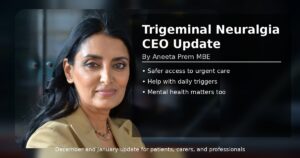
This trigeminal neuralgia CEO update covers what we have published and delivered across December and January. It is written for patients, carers, and professionals who want clear information without noise. Trigeminal neuralgia CEO update also means something else: we stay steady, even when the pain does not.
Across winter, three issues kept coming up in messages to TNA UK. People needed safer access to urgent care. People needed practical help with daily triggers. People also needed reassurance that their mental health mattered as much as their medication.
What we focused on in December and January
Winter pressures make trigeminal neuralgia harder to manage. NHS waiting times can stretch out care. In addition, dental problems do not pause because someone has facial pain.
So, we emphasised what helps most in real life:
-
clear patient information
-
practical risk reduction
-
support that people can reach quickly
-
honest language about how severe this condition can be
Trigeminal neuralgia triggers and day-to-day protection
Triggers do not cause trigeminal neuralgia. However, they can set off pain because the nerve is already sensitised.
That is why we published practical guidance on common triggers such as brushing, chewing, talking, wind, and touch. We also made it clear that pain can happen with no trigger at all, and nobody should use that to dismiss a patient.
This is not about blaming the patient. It is about protecting daily life. Small changes can reduce avoidable contact, and that can help people keep eating, washing, and sleeping.
Urgent dental care and trigeminal neuralgia
Dental access is a safety issue for people with trigeminal neuralgia and facial pain.
Some patients describe being pushed into unnecessary dental work before anyone identifies trigeminal neuralgia. Others cannot get urgent dental care when they genuinely need it. In the worst cases, people describe desperation and unsafe self-management because they feel trapped between pain and access barriers.
We therefore set out the problem clearly. Trigeminal neuralgia can mimic tooth pain, so clinicians must be cautious. At the same time, patients still get real dental infections and emergencies, and they need urgent pathways that do not retraumatise them.
Visibility and public understanding
Trigeminal neuralgia remains under-recognised, even though the pain can be life-changing.
That is why public-facing education matters. It helps a person explain their condition quickly. It also reduces the risk of mislabelling severe neurological pain as anxiety, stress, or “just dental”.
During 2025, our campaign films linked to visibility and awareness passed significant view numbers across our digital channels. That tells us one thing. More people now recognise the reality of trigeminal neuralgia when they see it described plainly.
Disability, equality, and invisible pain
International Day of Disabled People matters to our community because trigeminal neuralgia can strip away basic function.
People may look well. Yet they may fear eating, speaking, washing, or stepping outside into the wind. We used that moment to reinforce a simple point: facial pain must be part of disability conversations, not an afterthought.
This is not about labels. It is about rights, inclusion, and practical adjustments.
Mental health and safety in facial pain
Severe pain does not stay in one lane. It affects sleep, work, relationships, identity, and hope.
That is why we continue to treat mental health as core, not optional. Trigeminal neuralgia has been described as the “suicide disease” in many patient accounts, and we never ignore that reality when people reach out.
If you are struggling, please do not wait for a crisis. Tell your GP. Tell your specialist team. Tell someone you trust. Pain is isolating, but you are not alone.
All TN FP patients deserve respect and must be believed
If you read nothing else, take this.
-
You deserve safe, respectful urgent care, including dentistry.
-
You deserve practical, usable guidance, not vague reassurance.
-
You deserve systems that act quickly when risk escalates.
Here is my position, stated carefully:
“Trigeminal neuralgia does not need hype. It needs truth, speed, and care that meets the reality of the pain. My job is to keep that standard visible, even when the system moves slowly.”
Aneeta Prem MBE
What comes next
We will keep publishing patient-safe guidance that helps people navigate winter pressures. We will also keep pushing for earlier recognition, better pathways, and joined-up care.
In the meantime, if you are new to TNA UK, start with these three reads:
-
Trigeminal neuralgia triggers and practical protection
-
Urgent dental care and trigeminal neuralgia
-
The TNA UK New Year message and the direction of travel