Does Stress Make Trigeminal Neuralgia Worse? What Actually Helps
“Stress does not cause trigeminal neuralgia. Yet many people living with TN say stress can make the condition harder to manage by worsening sleep, muscle tension, overload and coping. During April’s Stress Awareness Month, the more useful question is not whether stress exists, but what it does to the body and what may genuinely help when pain and pressure collide.” Aneeta Prem
Stress does not cause trigeminal neuralgia. However, many people living with TN say stress can make a merciless condition even harder to live with. The pain may be neurological, yet the burden around it is often sharpened by poor sleep, muscle tension, fear, overload and the exhausting effort of trying to function through pain. That is the distinction this article aims to make clearly and honestly.
Too much public advice still gets this wrong. People are told to “manage stress” as if that were a tidy, simple task. It is not. When someone is living with severe facial pain, vague reassurance is of little use. What people need is a careful explanation of what stress does to the body, where the science stops, and which practical steps may help reduce the extra strain. The timing matters too. Stress Awareness Month has been observed every April since 1992, and the 2026 theme is #BeTheChange.
Why stress can feel physical before it feels emotional
Stress is not simply a feeling. NHS guidance explains that stress can affect people physically, mentally and behaviourally. Physical symptoms can include headaches or dizziness, muscle tension or pain, stomach problems, chest pain or a faster heartbeat. Mental symptoms can include difficulty concentrating, struggling to make decisions, feeling overwhelmed and constant worry. Behavioural changes can include irritability, sleeping too much or too little, eating too much or too little, and avoiding people or places.
In plain English, stress can tighten the body, disturb sleep, cloud thinking and reduce coping capacity. In the short term, that response is designed to help people react. When it continues, it stops feeling protective and starts becoming part of the problem. For people with trigeminal neuralgia and facial pain, that can show up in familiar ways: a clenched jaw, tight shoulders, shallow breathing, poor sleep, irritability and the feeling that one more demand could tip the day over. Those are recognised stress responses, not personal failings.
What stress can and cannot explain in trigeminal neuralgia
This is the line that must stay clinically clean. Stress does not cause trigeminal neuralgia. TN is a neurological pain disorder. The NHS says attacks can be triggered by actions such as talking, smiling, chewing, brushing the teeth, washing the face, a light touch, shaving or putting on make-up, swallowing, kissing, a cool breeze or air conditioning, head movements and vibration. NINDS likewise describes attacks being triggered by vibration or contact with the cheek, teeth brushing, nose blowing, eating, talking and wind.
The safer and more useful position is this: stress may not explain the condition itself, but it can deepen the burden of living with it. If stress worsens sleep, increases muscle tension, reduces concentration and leaves someone feeling overwhelmed, the overall experience of trigeminal neuralgia can become harder to manage. That is a careful inference from recognised stress symptoms and recognised TN triggers, not an inflated claim that stress causes attacks in everyone.
What actually helps when pain and pressure collide
People do not need twenty tips. They need a short list of realistic actions that still feel possible on a bad day.
1. Calm the body before asking the mind to cope
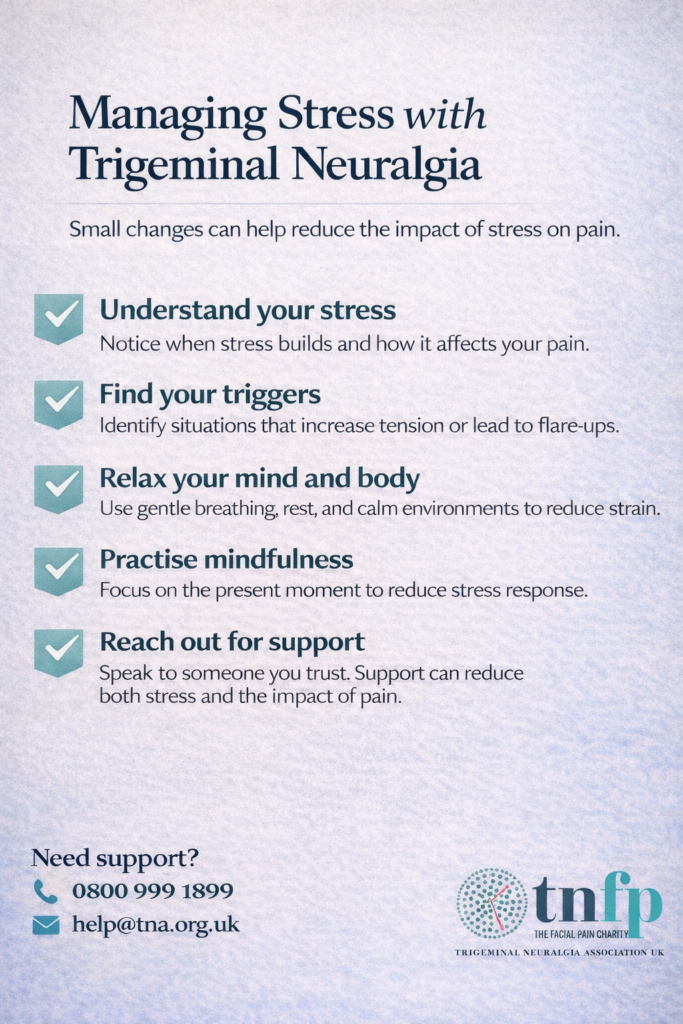
When stress rises, clear thinking usually falls. Start with the body. NHS guidance includes breathing and relaxation exercises among practical ways to reduce stress. A simple rule is to breathe in gently through the nose and breathe out slightly more slowly than you breathed in, repeating for a minute or two. It is not a cure for trigeminal neuralgia. It is a way to lower the sense of alarm and regain some control.
2. Treat sleep as part of pain management, not an optional extra
Poor sleep and stress feed each other. The NHS lists sleeping too much or too little among common changes linked with stress. For someone already living with severe facial pain, that matters. Better sleep will not solve TN, but it can improve patience, clarity and day-to-day resilience. Protecting sleep is not indulgent. It is part of reducing the wider burden of pain.
3. Reduce avoidable overload early
Pain narrows tolerance. So does stress. Extra noise, rushing, too many messages, unnecessary conversation, cold air and too many decisions can all feel harder when someone is already under strain. Because ordinary facial stimulation and even a cool breeze can trigger TN pain, reducing avoidable triggers and unnecessary overload is sensible, not self-indulgent.
4. Make decisions before pain and stress narrow your thinking
Stress can impair concentration and decision-making. That is why a written flare plan can help. Decide in advance what usually helps, what can wait, who to contact and what essentials should be close by. When pain and stress rise together, the plan is already there.
5. Lower the load, not just the emotion
Sometimes the most effective stress response is structural rather than psychological. Cancel one non-essential task. Delay one avoidable demand. Simplify one meal. Step away from one draining exchange. NHS advice on stress focuses on practical steps because small actions are often more realistic than grand plans.
6. Stay connected to practical support
Stress deepens in isolation. A support group, helpline, trusted relative or informed friend may not remove the pain, but it can reduce panic and restore perspective. When stress affects concentration and coping, practical support helps people think more clearly about what to do next.
The line TNA UK should own this April
If Stress Awareness Month is going to mean anything, it should mean something useful. For TNA UK, the strongest message is not that stress exists. Everyone knows that. The stronger message is that people living with trigeminal neuralgia and facial pain deserve guidance that is accurate, realistic and usable on a hard day. That fits the 2026 campaign theme, #BeTheChange, far better than empty slogans.
Stress does not cause trigeminal neuralgia. But unchecked stress can make an already difficult condition harder to live with by affecting sleep, muscle tension, concentration and coping. People with TN and facial pain do not need to be told to “just relax”. They need honest language, practical methods and fewer avoidable pressures. The pain may be neurological, but the hidden burden is often stress, fear, poor sleep and overload. That is the part we can address more clearly and more usefully.
Stress (NHS)
https://www.nhs.uk/mental-health/feelings-symptoms-behaviours/feelings-and-symptoms/stress/
https://www.ninds.nih.gov/health-information/disorders/trigeminal-neuralgia
Aneeta Prem, London 1 April 2026