
 Living With TN at Easter
Aneeta Prem, London 31 March 2026
Living with TN at Easter often looks easier from the outside than it feels from within. It brings family, food, visitors and the expectation that life should feel lighter. For people living with trigeminal neuralgia and facial pain, it can bring something very different. Pain does not pause because the table is laid or the house is full.
Easter may still hold beauty, warmth and meaning, but it can also bring noise, tiredness, travel, changed routines and the pressure to look well when every part of the day has to be judged carefully. What food will be manageable? How long to stay? Whether the conversation will become exhausting. Whether it is wiser to leave early than to pay for it later.
To others, these adjustments may sound small. They are not. Often, they mark the difference between getting through the day and suffering afterwards. What looks like a short family visit may have taken planning, restraint and real effort. What looks like someone eating less, speaking less, or slipping away early may simply be sensible management of a condition that does not soften for the sake of appearances.
Food, company and the cost of staying
Meals can be one of the hardest parts. Easter, like most family occasions, often centres on food. Yet many people living with TNFP know that eating is not always simple, spontaneous or comfortable. Texture matters. Temperature matters. Timing matters. Even when a meal looks inviting, the real question is often not what you would like to eat, but what you can eat without worsening pain.
There is no shame in choosing food you can manage over food that simply looks festive. Soup, mashed vegetables, soft pasta, yoghurt, porridge, smoothies or softer desserts may be far more realistic than foods that are hard, crunchy, chewy or very hot or cold. No prize is given for struggling through a meal that leaves you worse. A sensible choice is not a lesser one.
Company can be difficult for the same reason. Easter may bring comfort, but it can also be tiring. Talking, smiling, concentrating, listening to several conversations at once, and staying present in a busy room all take energy. For some people, cold air, fatigue and overstimulation add another layer of difficulty. That is not ingratitude. It is the reality of managing a serious condition in the middle of what others may assume is an ordinary day.
Family occasions can also create pressure to appear cheerful and keep going for the sake of others. Many people living with TNFP become skilled at concealment. They shorten a visit without making a fuss. They move food around a plate rather than explain. Quietly, they leave the room. All too often, they try not to change the mood of the day. That effort often goes unseen.
What others may see is the hour you stayed. What they may not see is what it costs you to be there at all.
Planning without apology
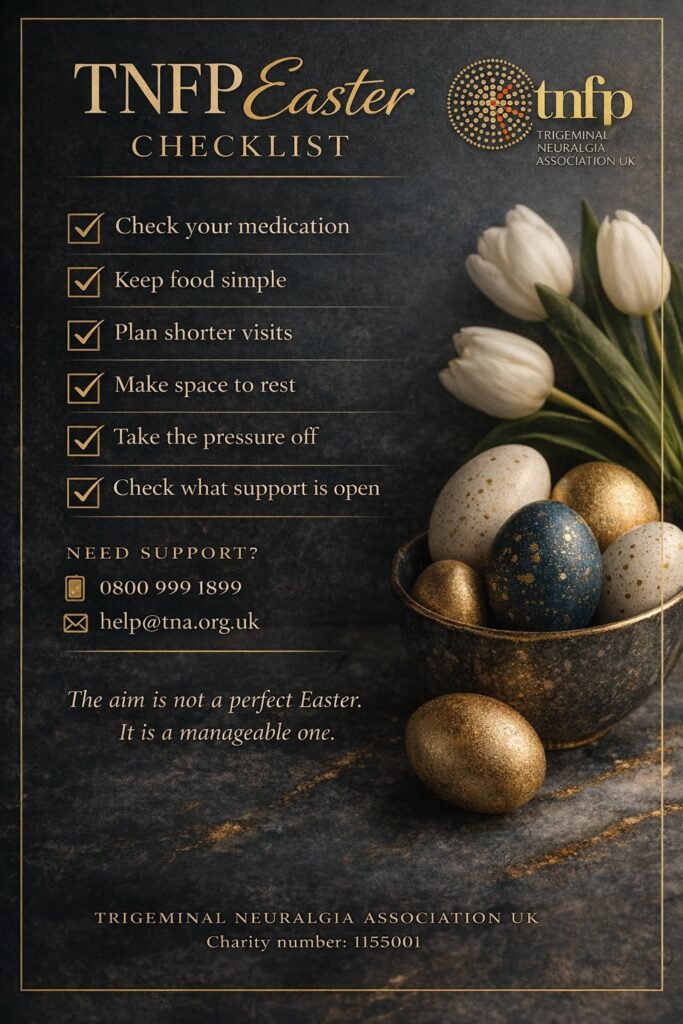
One of the wisest things a person with TNFP can do at Easter is to plan without apology. That is not negativity. It is judgement. If long visits leave you drained, make them shorter. If you need quiet breaks, take them. Should eating with everyone else feel too difficult, change the food or the timing. If travelling will wipe you out, be honest about that, too. Easter does not have to look a certain way to matter.
A successful day does not look perfect. For many people with TNFP, it is one that remains manageable.
Medication is another part of that planning. Bank holidays can catch people out. Prescriptions that felt safely in hand can suddenly run low. Pharmacies may be open for shorter hours. Routine services may be less accessible. That is why it makes sense to check early that you have enough medication for the full Easter period, rather than assume you can sort it later.
It also helps to know what support is open if pain worsens. Pharmacies may be operating on reduced hours, so checking ahead is sensible. If you need urgent advice when usual services are closed, NHS 111 can help direct you to the right support. Pain does not follow the calendar, but access to care often does.
Loneliness, dignity and what is possible
Easter can also sharpen loneliness. Not everyone has family around them. Not everyone has an easy home life. Not everyone can take part in celebrations without feeling the distance between what the season promises and what their own life currently is. Illness makes that contrast harder. Public holidays do the same. If Easter feels difficult this year, that does not mean you are failing at it. It means you are meeting the day as it is, not as it appears in other people’s photographs.
Living with TN often requires a level of planning, restraint and endurance that other people do not see. Patients are often praised for carrying on. What they deserve is respect for the complexity of what carrying on requires. The real achievement is not performance. It is knowing your limits, respecting them, and still finding a way to remain part of life where you can.
Perhaps the most sensible way to think about Easter with TNFP is not in terms of perfection, but in terms of what is possible. A manageable meal. A shorter visit. Medication sorted. Support numbers to hand. Enough honesty to say when something is too much. Enough self-respect not to turn that into guilt.
That is not giving in. It is a judgment.
If there is hope in Easter, it may not be found in ease, but in knowing your limits, preparing properly, and making choices that allow you to stay part of life without paying too high a price for it. For many people living with TNFP, that is not a small achievement. It is what makes the day possible.
Living With TN at Easter
Need support? 0800 999 1899 | [email protected]