
Trigeminal neuralgia triggers: practical ways to reduce avoidable pain
By Aneeta Prem MBE
Trigeminal neuralgia (TN) can cause sudden, severe facial pain. It may feel sharp, stabbing, or like an electric shock. International diagnostic descriptions emphasise that harmless sensations can trigger attacks, and some people also have ongoing background pain.
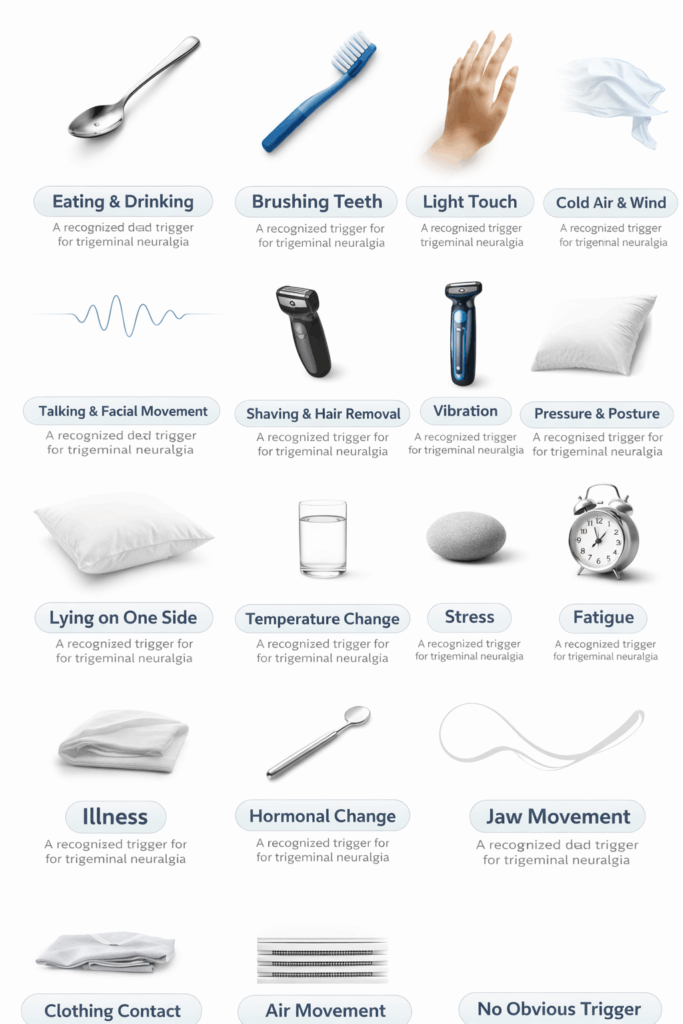
Many people notice trigeminal neuralgia triggers such as brushing teeth, eating, talking, or a cool breeze. Yet pain can also happen with no trigger at all. The NHS states this clearly, and it matters because “no trigger” should never be used to dismiss TN. nhs.uk+1
Below you will find practical steps that can reduce avoidable trigger contact in day-to-day life. These steps do not cure trigeminal neuralgia. Even so, they can protect the basics: eating, hygiene, sleep, and confidence.
Watch the video
A trigger does not cause trigeminal neuralgia. Instead, it can set off pain because the trigeminal nerve is already sensitised. The NHS lists common triggers, including talking, smiling, chewing, brushing teeth, washing the face, light touch, shaving or putting on make-up, swallowing, kissing, a cool breeze or air conditioning, head movements, and vibration such as walking or travelling in a car. It also says pain can occur with no trigger whatsoever. nhs.uk+1
So the aim is not to control your life. It is to reduce avoidable activation where you can.
The four-word rule that helps
During a flare, many people do best with:
Less cold. Less touch. Less force. Less vibration.
That simple filter helps you choose what to change today, and what to leave alone.
Trigeminal neuralgia triggers: a practical guide to solutions
Trigeminal neuralgia triggers from eating and drinking
Chewing, swallowing, and temperature changes can be triggers. nhs.uk+1
Practical steps that often help:
-
Choose lukewarm food and drinks. Avoid extremes of heat and cold.
-
Switch to soft meals during flares, such as soups, yoghurt, porridge, soft pasta, and mashed vegetables.
-
Cut food smaller than usual. Then take small bites and pause between mouthfuls.
-
Avoid wide bites when pain is active. Hard crusts and big sandwiches can be difficult.
-
Keep a “flare menu” of five safe options, so you are not deciding while in pain.
Why this can help: less jaw movement and less temperature shock usually mean fewer avoidable set-offs.
Trigeminal neuralgia triggers from brushing teeth and mouth care
Brushing teeth is a recognised trigger. It is also a reason TN is mistaken for a dental problem. nhs.uk+1
Practical steps that often help:
-
Use a very soft toothbrush.
-
Use warm water, not cold.
-
Brush gently and stop before pain escalates.
-
Brush in short bursts with pauses.
-
If vibration is a trigger, avoid electric toothbrushes during flares.
Keep this in mind: protecting oral health still matters. If brushing becomes difficult, ask your dentist for adjustments rather than forcing through severe pain.
Trigeminal neuralgia triggers from cold air, wind, fans and air conditioning
A cool breeze or air conditioning is a common trigger. nhs.uk+1
Practical steps outdoors:
-
Shield the cheek and jaw with a soft scarf or face covering.
-
Turn your face away from the wind when walking.
-
Avoid rushing between temperature extremes where possible.
Practical steps indoors:
-
Sit away from vents and fans.
-
Redirect airflow rather than lowering the temperature.
-
Create a still-air spot where nothing blows onto your face.
This helps because airflow can irritate a sensitive nerve even when the room is not particularly cold.
Trigeminal neuralgia triggers from light touch, washing and skincare
The NHS lists washing the face, light touch, shaving, and putting on make-up as possible triggers. nhs.uk+1
Practical steps that often help:
-
Pat your face dry, rather than rubbing.
-
Use soft cloths and avoid scratchy towels.
-
Apply skincare with minimal pressure.
-
Keep hair off the face if brushing across the cheek sets pain off.
-
Choose softer collars and fabrics near the jaw and neck.
Light touch can be enough to trigger pain. That is why gentler routines matter.
Trigeminal neuralgia triggers from talking, smiling and jaw movement
Talking, smiling and chewing are listed triggers. nhs.uk+1
Practical steps that often help:
-
Shorten calls during flares.
-
Use texts or voice notes when speaking is difficult.
-
Take small pauses while talking if pain is building.
-
Avoid chewing gum if repeated jaw movement sets pain off.
This is pacing, not giving up. It is also a sensible way to reduce repeated activation.
Trigeminal neuralgia triggers from shaving and grooming
Shaving or putting on makeup are listed triggers. nhs.uk+1
Practical steps that often help:
-
Slow down and use a gentle technique.
-
Avoid electric tools during flares if vibration is a trigger.
-
Groom at a time of day when pain is usually calmer.
-
Reduce frequency during flare periods if you need to.
Trigeminal neuralgia triggers from vibration, walking and travel
Vibration is listed as a trigger, including walking or travelling in a car. nhs.uk+1
Practical steps that often help:
-
Reduce drafts on your face during travel.
-
Use head and neck support if movement triggers you.
-
Avoid vibrating tools near the face during flares.
If walking itself triggers pain, try shorter, slower indoor steps. Also, choose routes with less wind.
Trigeminal neuralgia triggers from sleep position and pillow pressure
Head movements can be triggers, and many people notice certain positions worsen pain. nhs.uk+1
Practical steps that often help:
-
Try a different pillow height or firmness.
-
Avoid sleeping on the painful side if possible.
-
Avoid resting your face on your hand during a flare.
-
Move your head slowly if sudden turns set pain off.
Small changes can reduce repeated overnight irritation.
When trigeminal neuralgia pain happens with no trigger
This is common. It is also recognised. The NHS states pain can occur spontaneously with no trigger whatsoever. nhs.uk+1
If this is your pattern, do not waste energy blaming yourself. Focus on stability: warmth, hydration, rest, and reducing unnecessary face contact.
A small daily habit that can build momentum
This does not treat trigeminal neuralgia. However, it can reduce panic and help you feel steadier.
Breathing
The NHS offers simple breathing exercises for stress that focus on gentle breathing and steady counting. nhs.uk
Try this:
-
Breathe in gently through your nose.
-
Breathe out slowly.
-
Count steadily if it helps.
-
Continue for at least a few minutes.
Keep it light. The goal is calm control, not forcing the breath.
A short walk, if walking is not a trigger for you
Walking will not “fix” TN. Still, a short daily walk can support sleep and mood. If cold air triggers you, cover your face. If vibration triggers you, keep it gentle and consider indoor steps instead. nhs.uk+1
Momentum is built through repeatable steps, not heroic effort.
Treatment and alternative approaches: the accurate position
Trigger management can reduce avoidable activation. It does not replace diagnosis or treatment.
The NHS states that carbamazepine is the only medicine licensed in the UK specifically for trigeminal neuralgia. nhs.UK NICE guidance also describes carbamazepine as the only licensed anticonvulsant with proven efficacy for TN, with specialist options if it is not suitable or not effective. CKS+1
Homeopathy
If you mention homoeopathy, it needs to be framed accurately. The NHS cites the House of Commons Science and Technology Committee’s conclusion that homoeopathic remedies perform no better than a placebo. nhs.uk+1 NHS England has also published summaries reaching the same overall conclusion. NHS England+1
If someone chooses to use homoeopathy, it should not replace prescribed treatment or specialist care.
One question for you
What are your most common trigeminal neuralgia triggers, and what practical step helps you most?
If you want further support and information, visit tna.org.uk. Call 08009991899 option 1 or email [email protected]
Outbound links
-
NHS symptoms and triggers: https://www.nhs.uk/conditions/trigeminal-neuralgia/symptoms/ nhs.uk
-
NHS treatment: https://www.nhs.uk/conditions/trigeminal-neuralgia/treatment/ nhs.uk
-
NICE CKS management: https://cks.nice.org.uk/topics/trigeminal-neuralgia/management/management/ CKS
-
ICHD-3 definition: https://ichd-3.org/13-painful-cranial-neuropathies-and-other-facial-pains/13-1-trigeminal-neuralgia/13-1-1-classical-trigeminal-neuralgia/ ICHD-3
-
Royal College of Surgeons guideline (PDF): https://www.rcseng.ac.uk/-/media/files/rcs/fds/guidelines/trigemina-neuralgia-guidelines_2021_v4.pdf Royal College of Surgeons
-
NHS breathing exercises: https://www.nhs.uk/mental-health/self-help/guides-tools-and-activities/breathing-exercises-for-stress/ nhs.uk
-
NHS homoeopathy: https://www.nhs.uk/tests-and-treatments/homeopathy/ nhs.uk