Beyond Trigeminal
Neuralgia.
When facial pain resembles toothache or trigeminal neuralgia, getting the diagnosis right changes what happens next.
A person with facial pain may first seek help from a dentist. That is often appropriate. However, if careful assessment finds no dental cause, further dental treatment may not resolve the pain and could sometimes worsen it.
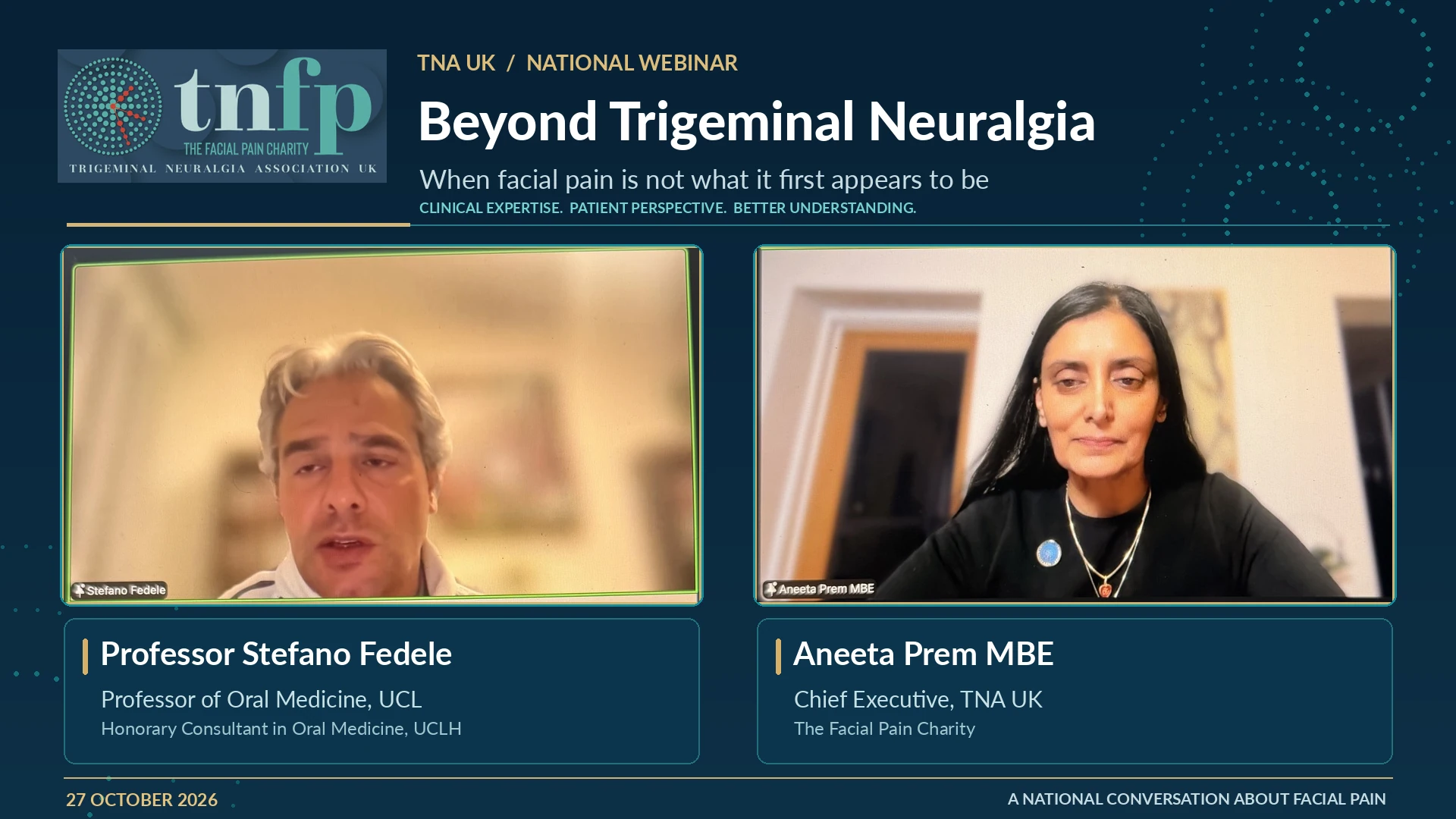
At TNA UK’s national webinar, Professor Stefano Fedele explained how clinicians distinguish different types of orofacial pain. He is Professor of Oral Medicine at University College London and an Honorary Consultant in Oral Medicine and Facial Pain at University College London Hospitals. Aneeta Prem MBE, Chief Executive of TNA UK, hosted the discussion.
Why an accurate facial pain diagnosis matters
Toothache, stabbing sensations, burning, pressure, numbness and aching can overlap in the way people describe them. Their causes, however, may be very different. For that reason, the pattern of pain, duration of attacks, examination findings and any changes in sensation all matter.
Trigeminal neuralgia (TN) typically produces abrupt, severe, electric shock-like attacks, often triggered by light touch or ordinary activities such as eating or washing. Some people also have a more continuous background pain. When symptoms do not fit TN, a dentist or doctor must also consider dental disease and other possible causes.
Clinical expertise and patient experience
Professor Fedele’s clinical and research work encompasses oral medicine and chronic facial pain. Aneeta brought the perspective of someone living with bilateral trigeminal neuralgia, as well as her experience leading a national patient charity and working to improve awareness and support.
Guest clinical expert
Professor Stefano Fedele DMD PhD
Professor of Oral Medicine at UCL and Honorary Consultant in Oral Medicine and Facial Pain at UCLH. UCLH professional profile ↗
Webinar host & patient advocate
Aneeta Prem MBE
Chief Executive of TNA UK. Her lived experience informs the charity’s advocacy, patient education and engagement with healthcare professionals.
Different causes of persistent facial pain
1. Pain in a tooth that may not come from the tooth
Persistent idiopathic dentoalveolar pain can cause continuing pain in a tooth, an extraction socket or the surrounding area. Appropriate examination and investigations find no identifiable local cause.
Painful post-traumatic trigeminal neuropathy is a different condition, associated with nerve injury and clinical evidence of altered sensation or trigeminal nerve dysfunction. Persistent pain after a root canal or extraction does not, by itself, prove nerve injury. Therefore, a professional assessment may be needed to distinguish these conditions.
2. Persistent idiopathic facial pain
Persistent idiopathic facial pain (PIFP) is typically ongoing and poorly localised, and does not follow the precise path of a peripheral nerve. Dental causes and other possible explanations need to be assessed appropriately. Pain is no less real because imaging is normal or no visible injury is found.
3. Burning mouth syndrome
Burning mouth syndrome can cause burning, scalding or stinging sensations on the tongue or elsewhere in the mouth. The oral lining can look normal. However, clinicians should consider other causes of oral burning, including infection, dryness, medicines, nutritional deficiencies and systemic illness, before diagnosing primary burning mouth syndrome.
Researchers are investigating changes to small sensory nerve fibres and pain processing in some patients. These ideas are still developing; there is no single diagnostic test or universally effective treatment.
4. Temporomandibular disorders and muscle pain
Temporomandibular disorders (TMD) and myofascial pain may produce discomfort around the jaw, temples and ear, sometimes worse when chewing or moving the jaw. Assessment should consider muscles, joints and other possible causes. Clenching or grinding may be relevant, but cannot explain every case. Treatment is often conservative and individualised.
5. Other possibilities
Headache disorders, sinus or oral disease, nerve-related pain, and less common conditions can sometimes be confused with TN or toothache. A clinician may need to involve oral medicine, dental specialists, neurology or other services. Clinicians should not automatically attribute ongoing symptoms to a single diagnosis without adequate investigation.
Questions to take to your appointment
- What clinical features support the suggested diagnosis?
- If the pain is felt in a tooth, what evidence shows that the tooth itself is responsible?
- Do I have short attacks, continuous pain or both — and why is that relevant?
- What other explanations have been considered, and are any tests needed?
- Would referral to oral medicine, neurology or a specialist facial pain service help?
- What are the expected benefits and risks of the treatment being suggested?
Psychological support or pain management strategies can be useful alongside physical assessment and treatment. That does not mean the pain is imagined.
A few clear answers.
Can trigeminal nerve pain feel like toothache?
Yes. Pain associated with the trigeminal nerve can be perceived in teeth or gums. Appropriate dental assessment is still important, but irreversible dental procedures should have a sound dental indication.
Does normal imaging mean facial pain is not real?
No. Several chronic pain conditions have no obvious abnormality on routine imaging. Instead, diagnosis depends on the history, examination, appropriate tests and specialist judgement.
Why can the mouth burn when it looks normal?
Burning mouth syndrome is one possibility. Clinicians may also investigate dry mouth, infection, deficiencies, medication effects and relevant medical conditions.
When is referral worth asking about?
When pain is persistent, severe, unexplained or does not respond as expected, a referral may clarify the diagnosis and suitable management. Sudden neurological symptoms, significant swelling or problems breathing or swallowing require urgent clinical assessment.
References and further reading
About this report. This is an editorial summary of topics discussed at TNA UK’s 27 October 2026 webinar, supported by the reference sources above. It is not a verbatim transcript or individual medical advice. The guest speaker has not been represented as independently approving this written summary.
Explore more expert perspectives and patient information.
Expert Webinars →