
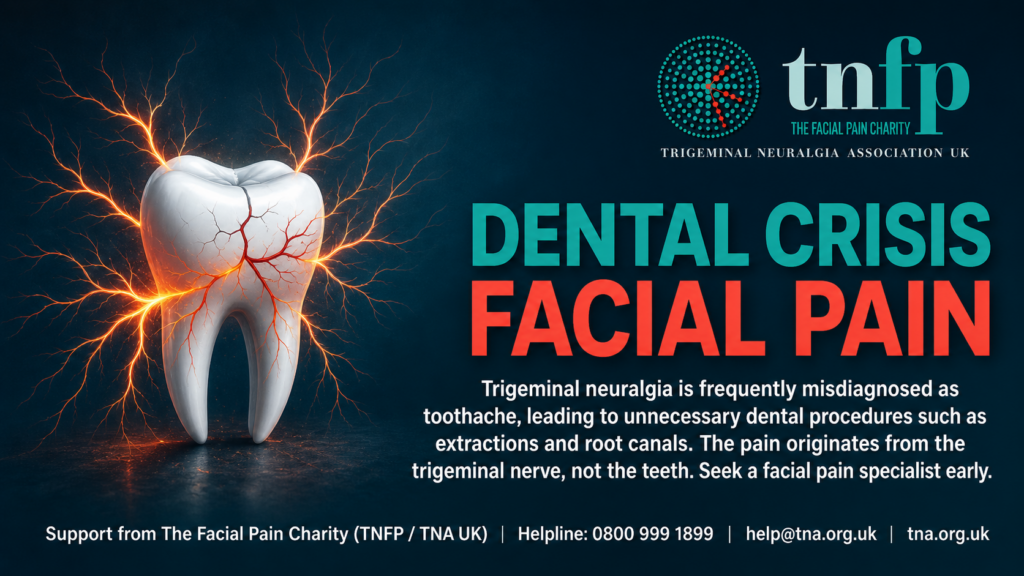
 Dental Crisis, Facial Pain
The dental crisis has returned to the spotlight after the Competition and Markets Authority opened a market study into private dental services on 5 March 2026. The regulator says it wants to know whether the market is working well for consumers across the UK. Government material has described the sector under review as the £8 billion private dentistry market. (gov.uk)
For people living with trigeminal neuralgia and severe facial pain, this is not only about price. It is about what happens when you are already in pain and still cannot get through the system quickly enough. When dental care is hard to reach, everything becomes harder. Anxiety rises. Decisions feel more urgent. The search for the right help can become another burden in itself.
NHS dental access is still under strain
Official evidence shows how much pressure remains in the system. The Adult Oral Health Survey 2023, published in December 2025, says the data was gathered between June 2023 and April 2024. It reports that the oral health workforce was under severe pressure and that services had not recovered to pre-COVID NHS levels during that period. The same material says the most common reason for infrequent attendance was being unable to find a dentist. (gov.uk)
Professional bodies have said the same in sharper terms. In July 2024, the British Dental Association said unmet need for NHS dentistry in England had reached 13 million adults. That is the BDA’s estimate, so it should be attributed that way, but it remains one of the clearest signs of how badly access has slipped. (bda.org)
Why do facial pain patients feel this first?
For someone with TN or severe facial pain, the problem starts at the beginning. What happens when the first door is harder to open?
Usually, it means more waiting. It means more uncertainty, more time trying to work out where to go next, and sometimes more pressure to pay privately because that seems like the only option left. That is an inference from the access evidence and from the way patients move through services, but it is a fair one. When dental access is stretched, people already living with pain often carry the weight of that failure first. (gov.uk)
Trigeminal neuralgia is not a dental condition. Even so, many people with facial pain first enter the system through dental routes or primary care before they reach the right specialist support. If those early routes are slow, disjointed or too expensive, the whole journey becomes more stressful than it should be.
The Government says it is improving access
Ministers say they are trying to change the picture. On 21 February 2026, the Department of Health and Social Care said the NHS had delivered 1.8 million more dental treatments in the first seven months of the financial year. It also announced measures aimed at improving access, prevention and continuity of care. (gov.uk)
That may help, but it does not mean the problem has gone away. Official survey evidence still describes a service under severe pressure. The regulator has now stepped in to examine the private market as well. That tells its own story. (gov.uk)
Parliament has already voiced its frustration. In April 2025, the Public Accounts Committee said the 2024 dental recovery plan had “comprehensively failed to deliver” and warned there was no future for NHS dentistry without deeper reform. It said the proportion of the population seen by an NHS dentist in the previous 24 months had fallen from 49% up to March 2020 to 40% by March 2024. (committees.parliament.uk)
What this means in practice
This is not about blaming dentists. It is not an argument against private care either. The point is simpler than that. People with severe facial pain should not have to fight delay, confusion or cost before they can reach the right help.
The CMA expects its market study to last 12 months. It plans engagement, evidence gathering and analysis from March to early September 2026. That process may answer important questions about pricing, transparency and whether the private market is working well for patients. The bigger question is the one patients will ask themselves. Does any of this make help easier to get, or are people still left in pain while the system gets in the way? (gov.uk)
That is how this inquiry will be judged.
Sources
Competition and Markets Authority, Private dental services market study, 5 March 2026.
Competition and Markets Authority, CMA launches review of private dentistry, 5 March 2026.
GOV.UK, Adult Oral Health Survey 2023, published 9 December 2025, updated 17 December 2025.
GOV.UK, Service use and barriers to accessing care, Adult Oral Health Survey 2023.
Department of Health and Social Care, Patients to benefit from improved access to dental appointments, 21 February 2026.
House of Commons Public Accounts Committee, No future for NHS dentistry without reform, 4 April 2025.
British Dental Association, 13 million unable to access NHS dentistry, 17 July 2024.
Aneeta Prem, London 10 April 2026