Trigeminal Neuralgia and Mental Health: Pain, Fear, Medication Side Effects and Support
Can trigeminal neuralgia affect mental health?
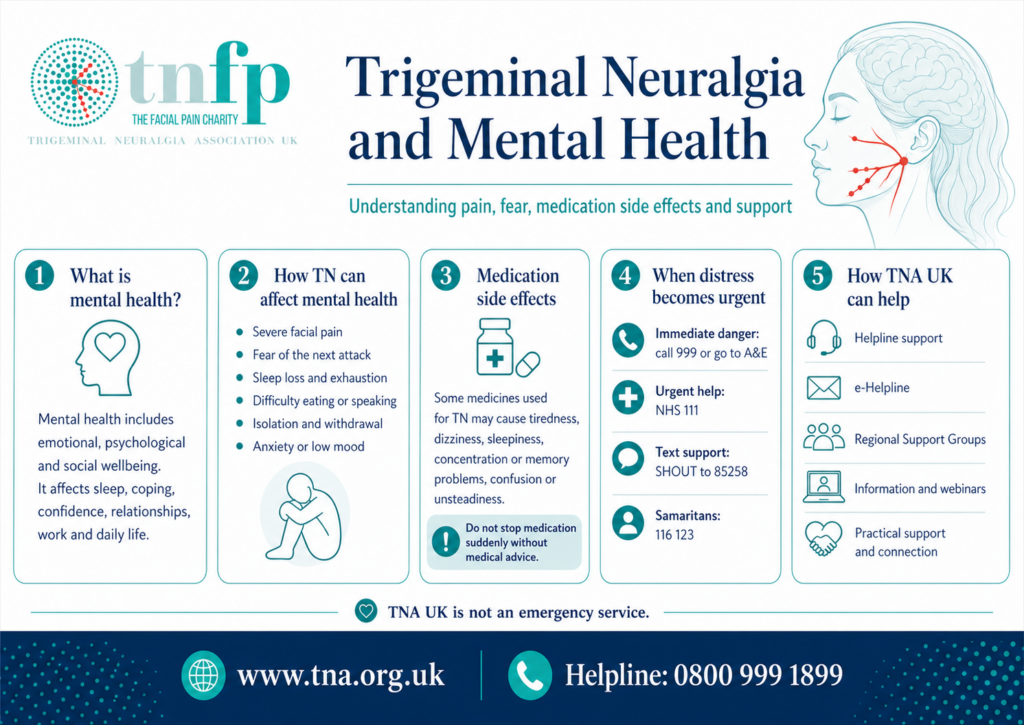
Yes. Trigeminal neuralgia can affect mental health because severe facial pain may disrupt sleep, eating, speech, work, family life and independence. Some people also live with fear of the next attack, isolation, low mood or anxiety. Medication side effects may add to this burden. Anyone with suicidal thoughts, self-harm thoughts or immediate safety concerns should seek urgent help.
Trigeminal neuralgia is often described by its physical pain. That matters, because the pain can be severe, sudden and frightening. However, people living with TN know that the condition can reach far beyond the face.
It can affect confidence. It can change how someone eats, speaks, sleeps, works and socialises. It can also affect relationships, family life and the ability to plan ordinary days.
Mental Health Awareness Week 2026 runs from 11 to 17 May and focuses on action. For people living with trigeminal neuralgia and facial pain, awareness alone is not enough. People need information, understanding and practical support.
TNA UK supports people living with trigeminal neuralgia and facial pain through information, helpline support, e-helpline support, Regional Support Groups, webinars and patient voice work.
What is mental health?
Mental health is not only the absence of mental illness. It includes emotional, psychological and social wellbeing. The World Health Organization describes mental health as a state of mental well-being that helps people cope with life’s stresses, realise their abilities, learn, work and contribute to their community.
Good mental health does not mean a person feels happy all the time. It means they have enough support, stability and capacity to manage life’s pressures.
When trigeminal neuralgia affects a person’s ability to eat, speak, sleep, work, leave the house or feel safe in their own body, it is not only a pain condition. It can become a mental health issue too.
How can trigeminal neuralgia affect mental health?
Trigeminal neuralgia can affect mental well-being in several ways. The pain itself may be intense, but the wider impact often comes from how unpredictable the condition feels.
Some people worry about brushing their teeth, washing their face, eating, drinking, speaking, smiling, touching the skin, going outside in cold wind or attending social events. For others, the fear of an attack can become part of daily life.
This can lead to anxiety, low mood, frustration, exhaustion and isolation. It may also affect work, finances, family roles and confidence.
These reactions are not a weakness. They are understandable responses to living with a condition that can be painful, disruptive and difficult for others to see.
The fear of the next attack
For many people living with TN, the pain is not limited to the attack itself. The fear of triggering the next attack can shrink daily life.
A person may stop eating certain foods. They may avoid talking for long periods. They may cancel plans because they cannot predict whether pain will flare. They may seem withdrawn when, in reality, they are trying to avoid pain, embarrassment or exhaustion.
This fear can become mentally draining. It can make a person feel as though they are constantly watching, waiting and calculating risk.
That is why support for TN must look beyond pain scores. It must also recognise fear, sleep loss, confidence, independence and emotional strain.
Sleep, eating, speech and isolation
Mental health is closely linked to ordinary daily functioning. TN can affect many of the things people rely on to feel steady.
Pain may disturb sleep. Poor sleep can then lower mood, reduce concentration and make pain harder to manage. Eating may become stressful if chewing triggers pain. Speaking may feel risky if facial movement sets off symptoms.
Isolation can also build slowly. A person may stop explaining the condition because they feel people do not understand. They may avoid social contact because pain is unpredictable. Over time, this can make the condition feel even heavier.
Support cannot remove every difficulty, but it can reduce the feeling of being alone.
Medication side effects can affect mental well-being
Medication can be essential for many people living with trigeminal neuralgia. For some, it reduces pain enough to make eating, speaking, sleeping or working possible. However, the treatment burden also matters.
Carbamazepine is recognised by NICE as the only licensed anticonvulsant medication with proven efficacy for trigeminal neuralgia. It can help some people, but side effects can affect daily life and should be discussed with a clinician.
Some medicines used for trigeminal neuralgia can cause side effects such as tiredness, sleepiness, dizziness, difficulty concentrating, memory problems, confusion, unsteadiness, nausea or visual disturbance. NHS information on carbamazepine lists side effects including sleepiness, dizziness and tiredness, while NICE and the BNF also list adverse effects such as sedation, dizziness, ataxia, nausea, vomiting, drowsiness and blurred vision.
This does not mean patients should stop prescribed medication without medical advice. It means side effects should be taken seriously and discussed with a GP, neurologist, pharmacist or specialist pain team.
A person may have less pain but still feel slowed down, unsafe on their feet, mentally foggy or unable to function as they did before. That can affect mental wellbeing in its own right.
Do not stop medication suddenly
No one should stop prescribed TN medication suddenly without medical advice. Stopping or changing medication without clinical guidance may be unsafe.
If side effects affect mood, safety, balance, concentration, memory, sleep or daily functioning, patients should speak to a GP, neurologist, pharmacist or specialist pain team.
It can help to write down:
- the name and dose of the medicine
- when side effects started
- how often they happen
- whether they affect work, driving, sleep or daily tasks
- any changes in mood, anxiety or distress
This gives clinicians clearer information and helps patients describe the full impact of treatment.
When distress becomes urgent
TN can be frightening and exhausting. For some people, severe pain, poor sleep, isolation or medication side effects may lead to crisis.
Anyone who develops new or worsening suicidal thoughts, self-harm thoughts, distressing thoughts or immediate fear for their safety should seek urgent help.
If there is immediate danger, call 999 or go to A&E. If urgent medical advice is needed but it is not an immediate emergency, contact NHS 111. NHS guidance says people who need help for a mental health crisis or emergency should get immediate expert advice and assessment.
If speaking feels too difficult, Shout provides free, confidential, 24/7 text support in the UK. Text SHOUT to 85258 to get support by text.
Samaritans can also be contacted free at any time on 116 123.
TNA UK can offer support, information and signposting, but it is not an emergency service and is not monitored continuously.
How TNA UK can help
TNA UK understands that trigeminal neuralgia affects far more than the face. It can affect sleep, confidence, communication, work, family life and emotional wellbeing.
We cannot take the pain away, but we can help people feel less alone.
TNA UK offers:
- helpline support
- e-helpline support
- Regional Support Groups
- information for people living with TN and facial pain
- webinars and events
- patient voice work
- campaigning and awareness
- support for families and friends who want to understand the condition better
Many people contact TNA UK because they want to speak to someone who understands the reality of living with TN. That connection can matter, especially when pain feels invisible to others.
TNA UK’s Freephone helpline is available on 0800 999 1899. The charity also provides Regional Support Groups for people living with trigeminal neuralgia and facial pain, as well as carers, partners, family members and friends.
What families and friends need to understand
A person with TN may cancel plans, avoid meals, stop talking during pain, become anxious before appointments or withdraw from social contact.
This does not mean they are being difficult. It may mean they are trying to avoid pain, embarrassment or exhaustion.
Families and friends can help by listening without judgment, taking pain seriously, being patient when plans change and recognising that the person may be dealing with both physical pain and emotional strain.
Small practical support can make a difference. That might mean helping with appointments, understanding food choices, checking in after a flare or giving someone space without making them feel forgotten.
What professionals should take seriously?
Professionals should take seriously not only pain severity, but also sleep loss, fear, medication side effects, isolation, work loss, safeguarding concerns and signs of emotional crisis.
Patients may not always describe mental health concerns directly. Some may say they are exhausted, frightened, not coping, unable to sleep or worried about taking medication. Others may describe feeling detached from normal life because so many daily activities have become linked with pain.
These statements matter.
Good support starts with believing that the whole burden of TN is real.
Trigeminal neuralgia support must look at the whole person
Trigeminal neuralgia care should not focus only on the pain attacks. It should also recognise what the condition does to ordinary life.
Pain, fear, sleep loss, isolation, loss of confidence and medication side effects can all affect mental health. People living with TN need clear information, timely medical advice and practical support from those who understand the condition.
TNA UK is here to support people living with trigeminal neuralgia and facial pain, and to help ensure their voices are heard.
Need support with trigeminal neuralgia?
If trigeminal neuralgia or facial pain is affecting your mental well-being, you do not have to manage it alone.
Contact TNA UK for information, helpline support, e-helpline support, Regional Support Groups and practical support from people who understand the condition.
If you feel at immediate risk, call 999 or go to A&E.
FAQs
Can trigeminal neuralgia affect mental health?
Yes. Trigeminal neuralgia can affect mental health because severe facial pain may disrupt sleep, eating, speech, work, relationships, confidence and independence. Some people also experience fear of the next attack, anxiety, low mood or isolation.
Can trigeminal neuralgia cause anxiety?
Trigeminal neuralgia may contribute to anxiety for some people because the pain can be sudden, severe and difficult to predict. Fear of triggering an attack may affect eating, speaking, brushing teeth, work and social life.
Can trigeminal neuralgia cause depression?
Some people living with TN experience low mood, hopelessness or depression, especially where pain is severe, sleep is disrupted, treatment is difficult or they feel isolated. Anyone with a persistent low mood should seek medical advice.
Can TN medication affect mood or mental well-being?
Some medicines used for TN can cause side effects that affect daily life, including tiredness, dizziness, concentration, memory, balance and, in some cases, mood. Patients should not stop medication suddenly, but should seek medical advice if side effects affect safety or well-being.
Should I stop taking TN medication if side effects affect me?
No. Do not stop prescribed TN medication suddenly without medical advice. Speak to a GP, neurologist, pharmacist or specialist pain team if side effects affect your mood, safety, sleep, balance, memory, concentration or daily life.
What should I do if TN makes me feel suicidal?
If there is immediate danger, call 999 or go to A&E. For urgent medical advice that is not an immediate emergency, contact NHS 111. If speaking is difficult, text SHOUT to 85258 for free 24/7 text support. Samaritans can also be contacted free at any time on 116 123. TNA UK can offer support and signposting, but it is not an emergency service.
Internal TNA UK links
TNA UK helpline:
https://www.tna.org.uk/helpline/
TNA UK contact page:
https://www.tna.org.uk/contact-us/
TNA UK Regional Support Groups:
https://www.tna.org.uk/regional-support-group/
TNA UK homepage:
https://www.tna.org.uk/
External source links
World Health Organisation, mental health definition:
https://www.who.int/news-room/fact-sheets/detail/mental-health-strengthening-our-response
Mental Health Foundation, Mental Health Awareness Week 2026:
https://www.mentalhealth.org.uk/our-work/public-engagement/mental-health-awareness-week
Mental Health UK, Mental Health Awareness Week 2026 theme:
https://mentalhealth-uk.org/get-involved/mental-health-awareness-days/mental-health-awareness-week/
NHS, trigeminal neuralgia treatment:
https://www.nhs.uk/conditions/trigeminal-neuralgia/treatment/
NHS, side effects of carbamazepine:
https://www.nhs.uk/medicines/carbamazepine/side-effects-of-carbamazepine/
NICE CKS, carbamazepine prescribing information:
https://cks.nice.org.uk/topics/trigeminal-neuralgia/prescribing-information/carbamazepine/
NICE CKS, trigeminal neuralgia management:
https://cks.nice.org.uk/topics/trigeminal-neuralgia/management/management/
BNF, carbamazepine:
https://bnf.nice.org.uk/drugs/carbamazepine/
NHS urgent help for mental health:
https://www.nhs.uk/nhs-services/mental-health-services/where-to-get-urgent-help-for-mental-health/
Shout text support:
https://www.headstogether.org.uk/programmes/give-us-a-shout/
Samaritans telephone support:
https://www.samaritans.org/how-we-can-help/contact-samaritan/talk-us-phone/