World Brain Day 2026: Access delayed is access denied for people with trigeminal neuralgia
World Brain Day takes place every year on 22 July.
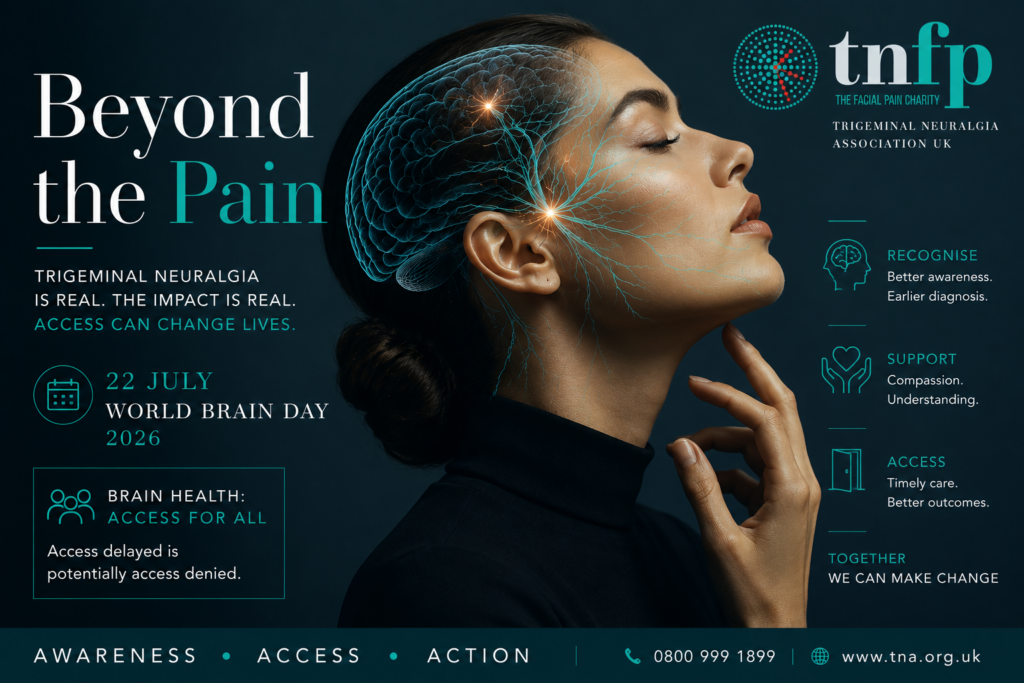
The theme for World Brain Day 2026 is Brain Health: Access for All. For people living with trigeminal neuralgia, that message is urgent, practical and personal.
Access can mean receiving an earlier diagnosis or securing the right referral. It can also mean reaching specialist care before severe pain damages a person’s work, sleep, confidence and hope.
Trigeminal neuralgia is a neurological pain condition involving the trigeminal nerve. Many patients describe the pain as electric, stabbing, shooting or shock-like. Everyday actions, including brushing the teeth, eating, speaking, washing the face or feeling wind against the skin, can trigger severe attacks.
Yet too many people still wait far too long for the right help.
At TNA UK, we believe that access delayed can become access denied.
A message from Aneeta Prem MBE, CEO of TNA UK
Aneeta Prem MBE, CEO of TNA UK, said:
“World Brain Day must include people living with trigeminal neuralgia and severe facial pain.
“Too many patients are passed from one appointment to another while their pain remains uncontrolled. Some undergo unnecessary dental treatment, including tooth extraction, before anyone considers a neurological cause. Others wait months to see the right specialist. During that time, they may stop eating properly, avoid speaking, fear going outside and become isolated from the life they once knew.
“Access is not a slogan for people with TN. It can mean the difference between being heard and being dismissed. It can also determine whether someone receives early treatment or endures years of avoidable suffering.
“No one with trigeminal neuralgia should have to fight to prove that their pain is real. Access to neurological care must include timely diagnosis, appropriate referral, specialist treatment, mental health support and patients’ voices.”
Why World Brain Day 2026 matters to people with TN
The World Federation of Neurology leads World Brain Day as an international campaign. In 2026, it highlights inequalities in access to brain health services and neurological care.
For people with trigeminal neuralgia, access often becomes the central issue.
Someone experiencing facial pain may first visit a dentist, GP, pharmacist or emergency department. That initial contact matters. However, when professionals do not recognise the signs of TN, the person may enter a distressing cycle of appointments, investigations and uncertainty.
Some patients receive dental treatment before anyone suspects a neurological condition. Others try standard painkillers, which generally do not relieve TN attacks. Meanwhile, the condition can affect sleep, eating, employment, relationships and mental health.
Brain health must include trigeminal neuralgia and severe facial pain.
Building on TNA UK’s work
TNA UK continues to raise awareness of brain health, neurological pain and barriers to treatment.
Our World Brain Day 2025 article explained why trigeminal neuralgia must form part of the wider brain health conversation.
During Brain Awareness Week 2026, we called for stronger public and professional understanding of TN.
We have also examined NHS waiting times and trigeminal neuralgia, including the harm caused by delays, unclear pathways and repeated appointments.
More recently, TNA UK published an evidence-based explanation of IV fosphenytoin for acute trigeminal neuralgia, following the publication of new research in Neurology.
This World Brain Day 2026 article takes the next step by concentrating on access to appropriate care.
What is trigeminal neuralgia?
Trigeminal neuralgia, often shortened to TN, causes severe pain in the area supplied by the trigeminal nerve.
The trigeminal nerve primarily carries sensation from the face to the brain. It also controls some of the muscles used for chewing.
TN pain usually arrives suddenly and may feel like an electric shock. Individual attacks are often brief, but they can occur repeatedly throughout the day. Some people with TN also experience continuous pain between the sudden attacks.
Because TN affects areas such as the face, jaw, teeth, gums and around the eye, many people initially believe that they have a dental problem. This response is understandable. Nevertheless, repeated or unexplained facial pain needs careful assessment, particularly when the attacks feel electric, stabbing, shooting or shock-like.
Early recognition can transform a patient’s route through care.
Where access breaks down
Access rarely fails at one point alone. Instead, delays can develop throughout a patient’s journey.
Delayed recognition
Facial pain can resemble a dental problem, sinus condition, migraine, ear disorder or another type of facial pain. As a result, healthcare professionals may not consider trigeminal neuralgia soon enough.
Delayed referral
Even when TN becomes a possible diagnosis, referral can take time. Depending on the individual case, a patient may need assessment through neurology, oral medicine, neurosurgery, pain services or a specialist facial pain service.
Delayed treatment review
Medication can help many people with TN. However, clinicians need to review treatment when pain remains uncontrolled or side effects become difficult to manage.
Delayed specialist care
Medication does not provide sufficient relief for everyone. Specialist assessment can help patients understand their diagnosis, imaging results, treatment options and whether a neurosurgical opinion may be appropriate.
Delayed emotional support
Severe facial pain can isolate people very quickly. Eating, speaking, smiling, washing and going outside may become frightening. Therefore, access must include emotional support and human understanding as well as clinical care.
Dental misdirection must be taken seriously
Many people with TN first seek help because the pain appears to come from their teeth or gums.
This does not mean that a dental professional has necessarily failed. Dentists can play a vital role because they may be the first professionals to recognise the pattern of TN.
However, when dental treatment does not explain or resolve the pain, clinicians should consider trigeminal neuralgia or another facial pain condition before undertaking further irreversible procedures.
Repeated dental treatment without a clear cause can lead to distress, financial cost and further delay. Better awareness across dentistry, primary care and neurology could help patients reach the appropriate service sooner.
TNA UK wants facial pain pathways to become clearer, faster and better understood.
Access is also a safety issue
Severe trigeminal neuralgia is not “just pain”.
Uncontrolled attacks can prevent people from eating, drinking, sleeping, working, speaking and leaving their homes. A light touch, a bite of food, a breeze or a simple movement may trigger intense fear.
Over time, patients can lose confidence, independence and hope. Mental health may also deteriorate when pain becomes relentless.
Healthcare professionals should take this distress seriously. They should ask about mood, safety, isolation, nutrition and the support available to the patient.
People with TN need more than a prescription. They need appropriate review, clear information, suitable referral routes and confidence that professionals take their concerns seriously.
What TNA UK wants to see
World Brain Day 2026 must encourage practical change.
Earlier recognition
GPs, dentists, pharmacists and emergency care professionals should understand the warning signs of trigeminal neuralgia and severe facial pain.
Clearer referral pathways
Patients need to know which service they should see, when referral should happen and what they should do if their symptoms worsen.
Better specialist access
Neurology, oral medicine, neurosurgery and pain services should work together. No patient should fall between separate parts of the health system.
Safe prescribing and regular review
Medication can transform life for some patients. However, clinicians must consider side effects, interactions, appropriate monitoring and inadequate pain control.
Stronger patient involvement
People living with TN should help shape healthcare services, research priorities, professional education and public policy.
Better recognition of mental health needs
Clinicians must consider severe pain and emotional distress together. Nobody should have to prove the seriousness of their suffering before receiving help.
What can patients do while waiting for care?
Waiting for care can be extremely difficult. However, practical preparation may make medical appointments more useful.
Patients may wish to:
- Record the frequency, duration and triggers of attacks.
- Note exactly where the pain occurs.
- Describe the pain using clear words such as electric, stabbing, burning, shooting or aching.
- List medicines already tried, including the dose, benefit and side effects.
- Record any dental investigations or treatment already received.
- Ask whether referral to neurology, oral medicine or a specialist facial pain service would be appropriate.
- Seek urgent medical advice if the pain becomes unmanageable.
- Contact TNA UK for information and support.
These steps do not replace professional medical advice. Nevertheless, accurate records can help a clinician understand the pattern of pain more quickly.
Questions to ask your clinician
Could this be trigeminal neuralgia or another facial pain condition?
This question may help when facial pain does not follow a typical dental or sinus pattern.
Do I need a specialist referral?
Referral may be appropriate when pain is severe, recurrent, worsening, unclear or not responding adequately to treatment.
Should I have an MRI scan?
An MRI scan often forms part of the assessment for suspected TN. It may help clinicians investigate possible causes of facial pain and identify whether a blood vessel appears to compress the trigeminal nerve. Your clinician can advise whether imaging is appropriate.
How should my medication be reviewed?
Ask about the dose, possible side effects, interactions and any monitoring you may need. You should also discuss contraception, pregnancy or plans for pregnancy where relevant.
Never stop or change prescribed medication without speaking to a qualified healthcare professional.
What should I do during a severe flare?
A written plan can reduce fear and uncertainty. It should explain whom to contact, when to seek urgent help and what information to provide.
Why TNA UK exists
TNA UK supports people affected by trigeminal neuralgia and facial pain.
We provide information, a helpline, support groups, webinars and patient-focused resources. We also raise awareness among healthcare professionals and the public because delayed recognition can cause avoidable suffering.
World Brain Day 2026 carries one clear message for TN:
Access to neurological care must include people living with trigeminal neuralgia and severe facial pain.
Getting support
If you or someone you know lives with trigeminal neuralgia or facial pain, TNA UK can provide information and support.
TNA UK helpline: 0800 999 1899
Website: www.tna.org.uk
If your symptoms require urgent medical attention but are not life-threatening, contact NHS 111.
Call 999 or attend an emergency department if there is immediate danger, new neurological weakness, collapse, confusion, a severe reaction to medication, suicidal thoughts, an inability to eat or drink safely, or if you cannot keep yourself safe.
TNA UK cannot diagnose conditions, prescribe medication or replace professional medical care.
Further reading
- World Brain Day 2026, World Federation of Neurology
- NHS information about trigeminal neuralgia
- World Brain Day 2025
- Brain Awareness Week 2026 and trigeminal neuralgia
- NHS waiting times and trigeminal neuralgia
- IV fosphenytoin for acute trigeminal neuralgia
Frequently asked questions
When is World Brain Day 2026?
World Brain Day 2026 takes place on 22 July.
What is the theme of World Brain Day 2026?
The theme is Brain Health: Access for All.
Why does World Brain Day matter for trigeminal neuralgia?
People with trigeminal neuralgia can experience delays in diagnosis, referral, treatment review and access to specialist care. World Brain Day provides an opportunity to call for practical improvements.
Is trigeminal neuralgia a brain health issue?
Yes. Trigeminal neuralgia is a neurological pain condition involving the trigeminal nerve. It should form part of discussions about brain health and access to neurological care.
Why do people with TN often visit a dentist first?
TN pain can appear to come from the teeth, gums or jaw. Consequently, many people seek dental help before anyone considers a neurological cause.
What should I do if I think I have trigeminal neuralgia?
Speak to your GP, dentist or another qualified healthcare professional. Ask whether trigeminal neuralgia or another facial pain condition could explain your symptoms. Seek urgent medical advice if the pain becomes unmanageable or you cannot eat or drink safely.
About the author
Aneeta Prem MBE is CEO of TNA UK. She lives with bilateral trigeminal neuralgia and underwent microvascular decompression surgery that did not relieve her pain. Her work focuses on improving awareness, reducing isolation and ensuring that people living with trigeminal neuralgia and facial pain are heard, believed and supported.
Aneeta Prem 16 July 2026