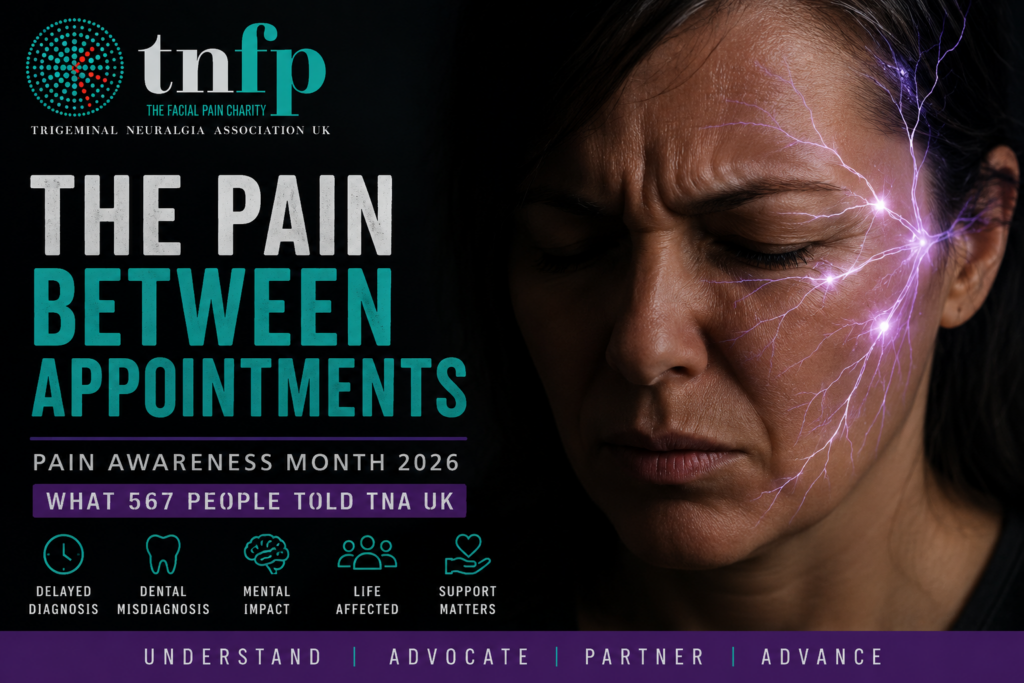
 What 567 people affected by trigeminal neuralgia and facial pain told TNA UK
Pain is usually recorded at the point of care. Much of its impact happens somewhere else: at breakfast, on the telephone, walking into cold air, trying to work, brushing teeth, speaking to family or deciding whether it is safe to make plans. For Pain Awareness Month 2026, TNA UK is looking beyond the pain score to what hundreds of people told us about the reality of living with trigeminal neuralgia and facial pain.
September is Pain Awareness Month.
For 2026, the International Association for the Study of Pain has chosen four words for its global campaign: Understand. Advocate. Partner. Advance.
Its first week focuses specifically on neuropathic pain.
For TNA UK, that makes this year’s campaign particularly relevant. Trigeminal neuralgia is not simply a question of how severe an attack feels. The consequences can reach far beyond the seconds or minutes in which pain strikes.
Our Patient Experience Survey 2024–25 gives us a way to examine some of that wider experience.
The final analytical cohort included 567 people who consented to the anonymised use of their responses. They told us about diagnosis, dental pathways, treatment, medication, daily life, isolation, emotional wellbeing and support.
The survey does not represent everybody living with trigeminal neuralgia or facial pain. It was an engaged, self-selecting group and the findings must not be treated as national prevalence figures.
But when hundreds of people answer the same questions, recurring experiences become harder to overlook.
The pain between appointments
A clinical appointment captures a moment.
Living with trigeminal neuralgia happens between those moments.
It happens when someone wonders whether eating will trigger another attack. When washing a face, brushing teeth, speaking, travelling or stepping into wind becomes something to think about rather than simply do.
In the TNA UK survey, 400 of 569 displayed responses to the question about daily activities, 70.3%, reported that trigeminal neuralgia or facial pain had a moderate or significant effect on ordinary activities.
That number matters because pain treatment cannot be judged by pain intensity alone.
Can someone eat?
Can they speak comfortably?
Can they wash and dress?
Can they work?
Can they sleep?
Can they leave the house without constantly calculating triggers?
Can they participate in family life?
These are not secondary questions. They are part of what treatment success means to the person living with the condition.
One respondent put it starkly:
“It impacts every part of my life even when I am not having an attack; the anxiety is still there.”
That is something a pain score cannot fully describe.
Before treatment comes recognition
For many respondents, the difficult part of the journey began before trigeminal neuralgia had a name.
Of 565 people who answered the survey question on diagnostic delay, 306, or 54.2%, selected a category indicating that diagnosis had taken longer than six months.
For 67 respondents, the reported delay was more than three years.
There was another striking finding.
Of the 567-person cohort, 235 people, 41.4%, reported that they had initially been misdiagnosed with toothache.
That does not prove that an individual dentist or doctor made a negligent decision. Facial pain can be complex, dental pain is common and individual cases require proper clinical assessment.
What the finding does show is that the boundary between dental pain and neurological facial pain deserves serious attention.
A patient can move through appointments, investigations and treatment while still not having an explanation that fits what they are experiencing.
For Pain Awareness Month, recognition must therefore be part of the conversation.
Awareness is not achieved simply when more people have heard the words “trigeminal neuralgia”. It matters when the right possibility is considered at the right time and the person can move towards appropriate assessment and care.
Treatment is not simply “works” or “doesn’t work”
The survey also tells a more complicated story about treatment than a simple success-or-failure headline would suggest.
Almost half of the cohort, 277 of 567 respondents, rated their current treatment as very or extremely effective.
That is important.
Patient evidence should not exaggerate poor outcomes by ignoring people who obtain meaningful relief.
At the same time, 90 respondents rated their current treatment as not so effective or not at all effective. Written responses also described medication burden, side effects, incomplete relief, uncertainty and fear that pain might return.
One respondent wrote:
“I am required to take such strong medication that my daily living is severely affected.”
This is why research and clinical conversations need to consider more than whether a medicine reduces attacks.
Pain control matters.
So do cognition, fatigue, balance, independence, the ability to work and the effect of treatment on ordinary life.
A treatment can be clinically valuable while still carrying a burden that matters deeply to the person taking it.
Both things can be true.
When pain becomes isolation
Severe facial pain can also change how somebody participates in the world.
Among 558 respondents who answered the question on loneliness and isolation, 375, or 67.2%, reported feeling isolated or lonely because of TN or facial pain at least once a month.
Written responses described people declining invitations, speaking less, avoiding cold or windy environments and becoming less confident about going out.
These experiences are particularly important because trigeminal neuralgia is usually invisible to everybody else.
A person may look well while privately making decisions around eating, speaking, travelling, socialising and the possibility of another attack.
For some, the consequences extend into work and money.
Among 564 respondents who answered the survey question about finances, 139, or 24.6%, reported a moderate, significant or extreme adverse effect on their financial situation.
One respondent told us:
“At 55 years old I could no longer work as a Specialist Public Health nurse.”
That is not evidence that everybody with TN will experience financial hardship or leave employment.
It is evidence that the consequences of severe pain can extend beyond the clinic and that work, financial security and participation deserve to be measured properly.
The emotional burden cannot remain hidden
The most difficult part of the survey must also be discussed carefully.
Of 556 respondents answering the question about mental health and emotional wellbeing, 443, or 79.7%, reported some frequency of impact. Of those respondents, 234, or 42.1%, reported an impact weekly or more often.
At a separate question, 173 of the 567-person cohort, 30.5%, answered yes when asked whether they had ever felt suicidal because of TN or facial pain.
This figure must not be sensationalised.
It is not a national suicide rate. It does not establish that trigeminal neuralgia alone caused suicidal thoughts, and TNA UK rejects sensational labels for the condition.
It is, however, a serious patient-reported safeguarding signal.
It tells us that emotional distress needs to be discussable.
Someone seeking help for severe facial pain should not have to choose between talking about physical pain and talking about what that pain is doing to their mental wellbeing.
Both matter.
“Listen to us”
Perhaps the shortest response in the survey says the most:
“Listen to us and stop minimising the pain.”
Patient testimony is not a substitute for clinical evidence.
Neither should it be dismissed as anecdote when it is gathered carefully and examined honestly.
The value of patient evidence is different.
It can show where experiences recur.
It can identify questions that need further research.
It can tell researchers whether the outcomes they are measuring reflect what matters in real life.
It can alert services to problems that may not be visible in clinical records.
And it can reveal the gaps between what a care pathway says should happen and what people report actually experiencing.
That is why TNA UK developed this survey.
Clinical definitions tell us what a condition is.
Patient evidence can help tell us what living with it does.
We need both.
From patient experience to evidence
There is an important discipline to this work.
TNA UK’s Patient Experience Survey 2024–25 is patient-led grey literature. It has not been peer reviewed and it is not a prevalence study.
The respondents were self-selecting. Individual diagnoses, procedures and treatment histories were not independently checked against medical records. Question bases vary because not everybody answered every question and some questions allowed multiple selections.
We state those limitations because evidence becomes weaker, not stronger, when limitations are hidden.
The survey cannot tell us that one experience caused another.
It cannot determine which treatment works best.
It cannot tell us what percentage of everybody with trigeminal neuralgia in Britain has had the same experience.
What it can do is document, at scale, what this substantial group of people reported and identify patterns worthy of clinical, research and policy attention.
That distinction matters.
Understand. Advocate. Partner. Advance.
The four themes of Pain Awareness Month 2026 provide a useful test for what should happen next.
Understand.
Listen carefully to what people report about pain, diagnosis, treatment, function, isolation and emotional wellbeing.
Advocate.
Make it easier for people to describe the full impact of pain and to reach appropriate information, assessment and support.
Partner.
Bring people living with pain into research early enough for their experience to influence the questions, study information, participation requirements and outcomes being measured.
Advance.
Keep pushing for better understanding of trigeminal neuralgia, earlier recognition, better-tolerated and more effective treatments, better evidence about who benefits from which intervention, and ultimately a future in which far fewer people have to organise their lives around facial pain.
Awareness should lead somewhere.
What TNA UK is doing with the evidence
TNA UK has supported people affected by trigeminal neuralgia since 1999.
Today that contact takes place through our helpline, e-helpline, Regional Support Groups, Friendship Line, webinars, membership community, patient information, surveys and research engagement.
The survey adds another dimension to that work.
It allows us to move beyond hearing individual experiences one at a time and begin examining where experiences recur across a much larger group.
We use patient evidence to help identify research priorities, strengthen professional education, improve patient information, inform our services and bring the patient voice into conversations with clinicians and researchers.
We are also strengthening the way TNA UK communicates research.
Our Research Hub follows current studies and clinical trials, explains new findings in plain English and asks the question that matters whenever a new treatment or study generates excitement:
What does the evidence actually show?
Patients deserve hope.
They also deserve accuracy.
A message from Aneeta Prem
Aneeta Prem MBE, Chief Executive of TNA UK and research lead for the Patient Experience Survey, said:
“The figures matter because they show where people can disappear between services. A patient may be seeking a diagnosis, coping with medication and withdrawing from ordinary life at the same time. Better care begins by seeing that whole experience.”
Pain Awareness Month is an opportunity to make pain more visible.
But visibility is only the beginning.
The people who answered TNA UK’s survey have already done something important. They gave us their experience.
Our responsibility is to use it carefully.
To listen without exaggerating.
To publish what the evidence supports.
To acknowledge what it cannot tell us.
To ask better questions.
And to make sure the experience of living with trigeminal neuralgia is part of the conversation about what comes next.
That is how awareness becomes evidence.
And evidence can become change.
About the evidence
The TNA UK Patient Experience Survey 2024–25 has a final analytical cohort of 567 respondents who consented to the anonymised use of their responses.
The survey covered 22 core questions spanning diagnosis, dental pathways, treatment, daily activities, emotional wellbeing, social connection, work, finances, support and open-text patient experience.
It is patient-led grey literature and has not been peer-reviewed. Respondents formed an engaged, self-selecting cohort. Findings should therefore be attributed to respondents in the TNA UK survey and must not be interpreted as national prevalence estimates or proof of clinical causation.
The complete report includes the methodology, denominators, limitations, questionnaire, technical notes, patient quotations and recommendations.
Prem A; Trigeminal Neuralgia Association UK. Pain Awareness Month 2026: What 567 people affected by trigeminal neuralgia and facial pain told TNA UK. TNA UK. 3 September 2026.
Sources
Trigeminal Neuralgia Association UK. TNA UK Patient Experience Survey 2024–25. Version 2.0.
International Association for the Study of Pain. Pain Awareness Month 2026: Understand. Advocate. Partner. Advance.
If pain is affecting your wellbeing
TNA UK provides information and support for people affected by trigeminal neuralgia and facial pain. TNA UK is not an emergency or crisis service.
If you are concerned about your mental health, seek help from an appropriate healthcare professional. If you or somebody else is in immediate danger, call 999 or attend the nearest Emergency Department.